
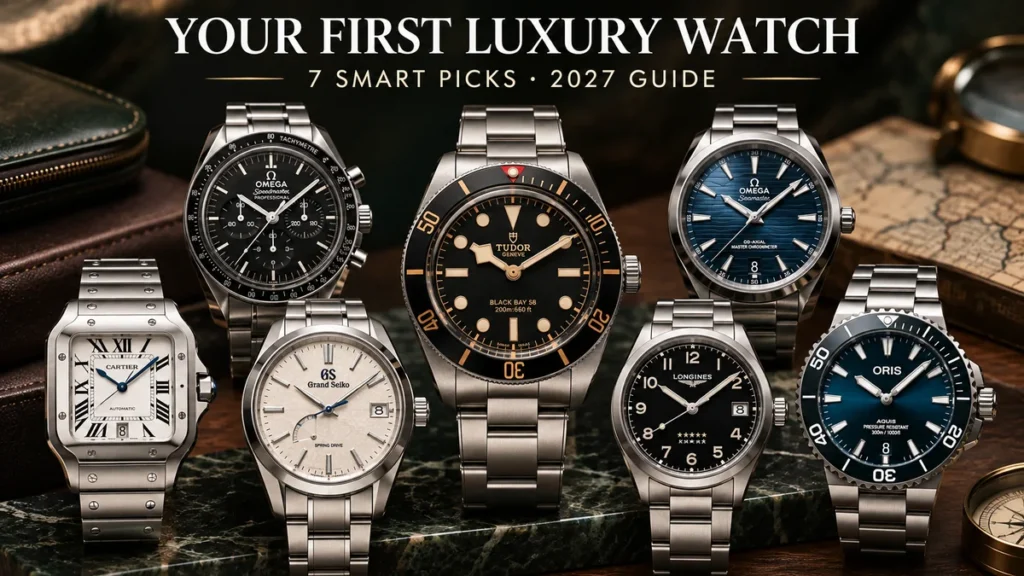
Your first luxury watch is less about finding “the best watch” and more about not regretting the money a year later. The most common regret isn’t buying the wrong brand. It’s buying a watch that doesn’t fit your wrist or your life, or stretching to a price that makes you nervous every time you wear it.
This guide gives you three questions to settle first, then seven picks between roughly $2,000 and $10,000 that work well as a first serious watch.
In this article
Three questions to answer before you shop
1. What’s your real budget?
Add 10% or more to the sticker price for sales tax, and remember a mechanical luxury watch needs a service every several years, which can cost several hundred dollars or more. We break down typical costs in our guide to how much a watch service costs. If the full amount would make you anxious about scratches, go one tier lower. A watch you’re afraid to wear is a bad purchase.
2. One watch, or the start of a collection?
If this will be your only nice watch for years, choose versatility: a steel case, a steel bracelet, 100 m or more of water resistance, and a dial that works with a T-shirt and a suit. If you already know you’ll buy more, you can pick something more specific, like a chronograph or a dress watch.
3. Does it fit?
Try it on, ideally at the end of the day when your wrist is slightly larger. Look at the lug-to-lug length, not just the diameter. If the lugs go past the edges of your wrist, it’s too big, whatever the spec sheet says.
7 first luxury watches that make sense
Tudor Black Bay 58: the safe, excellent choice
A 39 mm steel diver with a Manufacture movement, about 65 hours of power reserve, 200 m water resistance and a five-year transferable warranty. Tudor lists it from $5,225 on a steel bracelet, at the time of writing. It’s easy to wear, easy to buy, and still exciting.
Good for: a one-watch owner who wants something that does everything.
Omega Speedmaster Moonwatch: the story watch
The chronograph worn on the Moon in 1969, still hand-wound, now with Omega’s Master Chronometer 3861 movement. Prices start around $7,400 depending on crystal and bracelet. Two caveats: it’s only 50 m water resistant and you need to wind it every couple of days.
Good for: someone who loves the history and enjoys the ritual of a manual watch.
Omega Seamaster Aqua Terra: the quiet all-rounder
Often overlooked next to its louder siblings, the Aqua Terra is a sporty-elegant watch with 150 m water resistance and Omega’s anti-magnetic Master Chronometer movements, available in several sizes. It’s the closest thing to a “wear it everywhere” Omega.
Good for: office-to-weekend wear, especially if a dive bezel feels too sporty.
Cartier Santos or Tank: design over spec sheet
If you care more about how a watch looks than what’s inside, Cartier is the obvious place to start. The Santos is the sportier one, with an easy-swap bracelet system. The Tank is the elegant, rectangular classic, and the Tank Must is one of the most affordable ways into the brand. We compare them properly in Cartier Tank vs Santos.
Good for: buyers who want a design icon rather than a tool watch.
Grand Seiko: finishing you’ll notice
Grand Seiko’s case polishing and dial work routinely surprise people who are new to the brand. Many models use Spring Drive, Grand Seiko’s hybrid movement with a smooth, gliding seconds hand. Prices for a first Grand Seiko usually start in the mid-thousands.
Good for: someone who values craftsmanship over brand recognition. See Grand Seiko vs Rolex for how it stacks up.
Longines: Swiss luxury at the lower end
Longines offers proper Swiss luxury watches, from heritage divers to elegant pieces, often at a fraction of the price of the names above. It’s a good choice if your budget is closer to $2,000–$3,500.
Good for: a first Swiss luxury watch on a tighter budget. Also compare with Longines vs Tissot.
Oris: long power reserve, long warranty
Oris is an independent Swiss brand. Its in-house Calibre 400 offers a five-day power reserve and comes with an extended warranty and service interval. The Aquis diver and the vintage-styled Divers Sixty-Five are the usual starting points.
Good for: buyers who want low running costs and something a little less obvious.
What about Rolex?
A Rolex can absolutely be a first luxury watch, but popular steel models are hard to buy at retail without a purchase history at a dealer. If you want one, register interest with several authorized dealers and be patient. Or consider buying pre-owned from a reputable seller; our guide to where to buy luxury watches online explains the options.
New or pre-owned for your first luxury watch?
Buying new from an authorized dealer gets you the full manufacturer warranty, the box and papers, and the experience of being the first owner. Buying pre-owned lets someone else absorb the first drop in value. For many brands, a lightly used watch with papers costs noticeably less than new. For brands like Rolex, pre-owned is sometimes the only realistic route. Our guide to where to buy luxury watches online explains how to buy pre-owned safely.
The most common first-luxury-watch regrets
- Too big: a watch that looked great in photos overhangs the wrist. Always try it on.
- Too specialized: a dive watch for someone who wears suits daily, or a manual-wind chronograph for someone who wanted grab-and-go.
- Buying the brand, not the watch: choosing a model you don’t love just to own a certain name.
- Stretching the budget: a watch that feels too precious to wear ends up in a drawer.
- Ignoring running costs: servicing a luxury watch costs hundreds of dollars or more every several years.
If we had to pick one
For most first-time buyers, the Tudor Black Bay 58 is the best balance of quality, size, versatility and price, and you can buy it without waiting. If your style leans dressier, the Omega Aqua Terra or a Cartier Santos would be our alternative.