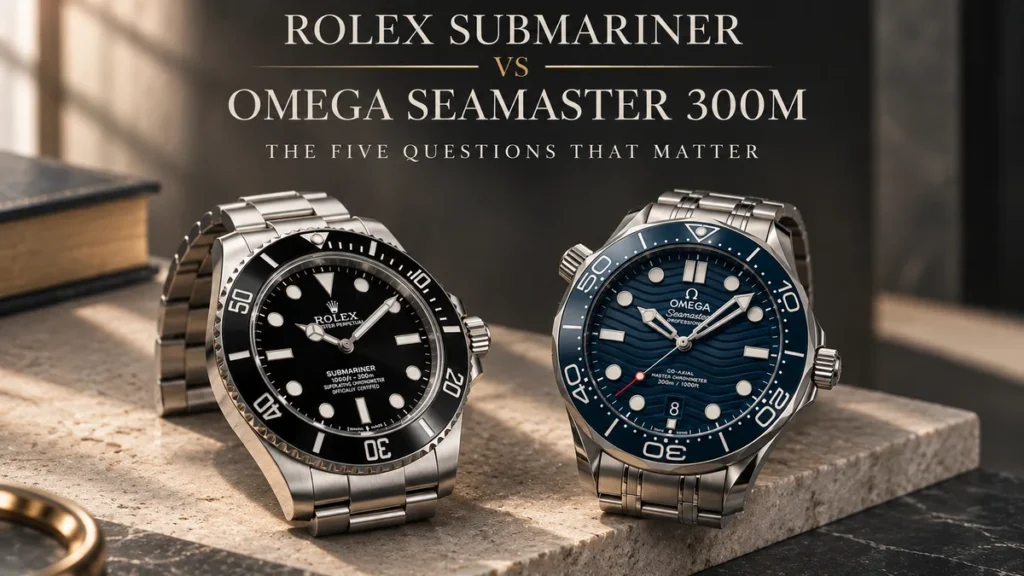
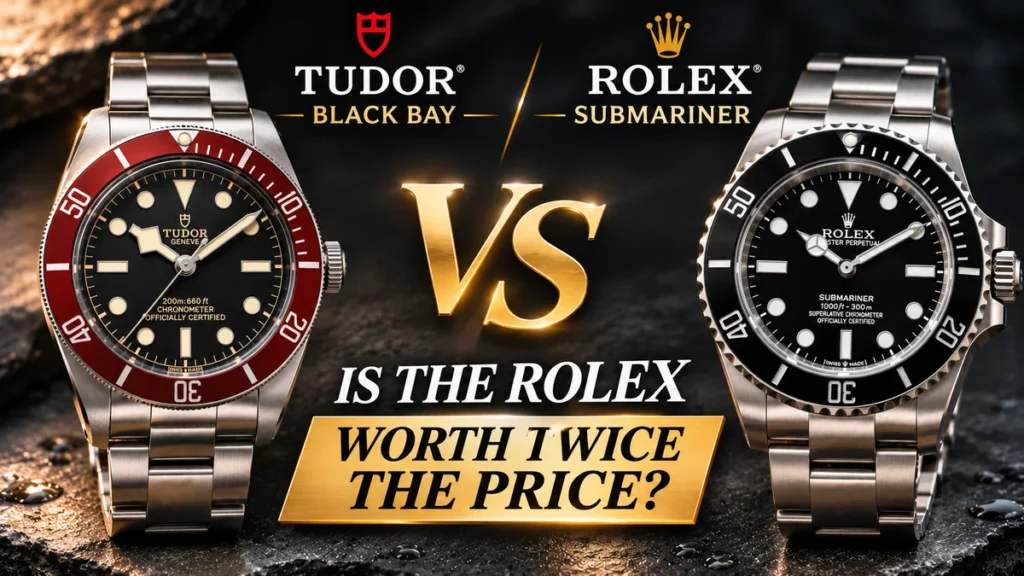
The Submariner costs roughly twice as much as a Black Bay, and you usually can’t walk out of a store with one. That’s the real comparison. Spec for spec, the two are closer than the price gap suggests. The Rolex wins on water resistance, bezel material and certified accuracy. The Tudor wins on value and on actually being available.
Short verdict: if you want a great steel dive watch now, buy the Black Bay. Wait for the Submariner only if the Rolex name, resale value and the last bit of refinement matter to you, and you’re willing to deal with the buying process.
In this article
Same founder, different roles
Tudor was created by Rolex founder Hans Wilsdorf as a more affordable sister brand, and the two companies are still closely linked. For decades Tudor used outside movements in Rolex-made cases. Today it makes its own “Manufacture” calibers, and the Black Bay is a heritage-inspired diver in its own right rather than a cheaper Submariner.
Spec comparison
| Tudor Black Bay (41 mm) | Rolex Submariner (no-date) | |
|---|---|---|
| Case diameter | 41 mm | 41 mm |
| Movement | Tudor MT5602 (Manufacture) | Rolex 3230 (Manufacture) |
| Power reserve | About 70 hours | About 70 hours |
| Certification | Master Chronometer (METAS) on current versions | Superlative Chronometer, −2/+2 s/day after casing |
| Water resistance | 200 m | 300 m |
| Bezel insert | Anodized aluminum | Cerachrom ceramic |
| Clasp adjustment | T-fit quick adjustment | Glidelock extension |
| Warranty | 5 years, transferable | 5 years |
Where the extra money goes
Bezel and finishing
The most visible difference is the bezel. Rolex’s ceramic insert keeps its color and resists scratches almost indefinitely. Tudor’s aluminum insert fades and picks up marks over the years, which some owners actually like because it ages the way vintage divers did. Under a loupe, Rolex’s case finishing and dial printing are also a step crisper.
Accuracy
Rolex guarantees −2/+2 seconds per day after the movement is cased, roughly twice as strict as standard COSC chronometer certification. Current Black Bay models carry METAS Master Chronometer certification, which tests the finished watch for accuracy and resistance to magnetism. Day to day, either will keep better time than most people need. COSC explains its own certification criteria here if you want the details.
Water resistance
300 m versus 200 m sounds significant, but it makes no practical difference for recreational diving, swimming or snorkeling. Both are proper dive watches.
Bracelet and clasp
Both clasps let you adjust the fit without tools. Rolex’s Glidelock offers finer steps and a longer range, which helps over a wetsuit or on a hot day. Tudor’s T-fit is quicker but has fewer positions. Older Black Bays with riveted-style bracelets divide opinion; try one on before judging.
Price and availability: the real decision
A steel Black Bay on a bracelet lists at a little over $5,000 ($5,325 to $5,450 depending on the bracelet, at the time of writing), and authorized dealers usually have it in stock. The Submariner’s list price is roughly double that, but list price is only half the story. Many authorized dealers prioritize existing clients, so new buyers often wait or turn to the secondary market, where steel Submariners typically sell above retail.
That premium works in reverse when you sell. A Submariner has historically lost far less of its purchase price than a Black Bay, which tends to sell used for noticeably less than new. If you plan to resell within a few years, the gap between the two narrows. Our guide to watches that hold their value explains why.
Don’t forget the Black Bay 58
If the 41 mm Black Bay feels big, the Black Bay 58 is a 39 mm, 11.7 mm-thick version with Tudor’s MT5400-U movement, about 65 hours of power reserve and 200 m water resistance. Tudor lists it from $5,225 on a steel bracelet, at the time of writing. Many people find it the more comfortable everyday watch of the whole group, including the Submariner.
Owning each one: warranty and service
Both brands give a five-year warranty on new watches bought from authorized dealers. Tudor’s is transferable and requires no registration, which is handy if you ever sell. Both use robust, modern movements designed for long service intervals, but a Rolex service at the brand typically costs more than a Tudor service. Budget for one full service in the first decade either way. Our guide to watch service costs explains what’s included.
Tudor questions people ask before buying
Is Tudor made by Rolex?
Tudor is a separate brand under the same ownership group, founded by Rolex’s founder. Today it designs and makes its own Manufacture movements rather than using Rolex calibers. It shares Rolex’s approach to robustness but has its own design identity.
Is a Black Bay a “real” luxury watch?
Yes. In-house movements, chronometer certification, a five-year warranty and excellent build quality put it firmly in entry-level luxury, alongside brands like Longines and Oris. See our luxury brand tier list.
What other Tudors should I consider?
The Black Bay 54 (37 mm, closest to Tudor’s first diver), the Black Bay Pro (a GMT with a fixed 24-hour bezel) and the titanium Pelagos 39. Each is a better fit than the 41 mm Black Bay for certain wrists and uses.
Who should buy which
Buy the Black Bay if you want an excellent dive watch this year without chasing a dealer. It also makes sense if you prefer a vintage look, or if you’d rather keep the difference for a second watch.
Buy the Submariner if this is your one big purchase and you’re willing to wait or pay a premium. It’s also the stronger choice if resale value matters to you, or if you simply want the reference that every other dive watch gets compared to.
Still undecided about Rolex? Our Submariner vs Omega Seamaster Diver 300M comparison covers the other obvious alternative.