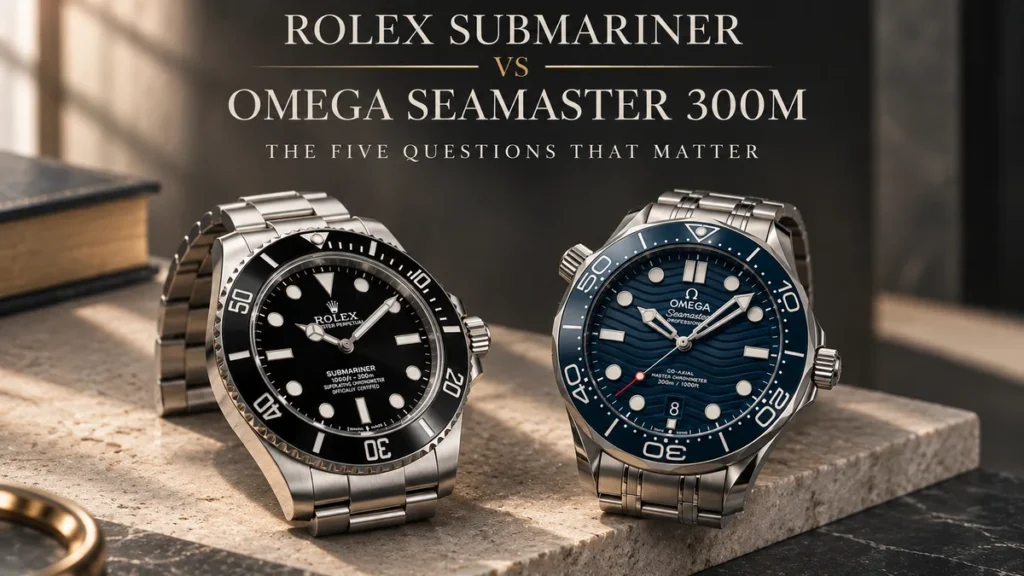
Both are steel dive watches with ceramic bezels, both cost more than most people spend on a car payment for a year, and both are excellent. What separates them is not quality but character. The Submariner is the restrained classic. The Seamaster Diver 300M is the more expressive, more technical-looking one, and it’s the watch you can actually buy this afternoon.
Rather than walk through every spec, here are the five questions that decide it for most buyers.
In this article
1. Can you actually buy one?
This is where most comparisons should start. The Seamaster Diver 300M is generally available at Omega boutiques and authorized dealers, often with some room to negotiate at independent retailers. The steel Submariner, by contrast, is frequently allocated to existing clients, and many buyers end up paying above list price on the secondary market.
If you want a watch for a specific date (a birthday, a promotion, a wedding), that alone may decide it.
2. Which one fits your wrist better?
| Submariner (124060) | Seamaster Diver 300M | |
|---|---|---|
| Diameter | 41 mm | 42 mm |
| Thickness | About 12.5 mm | 13.6 mm |
| Lug-to-lug | About 48 mm | 49.9 mm |
| Bracelet adjustment | Glidelock clasp, fine steps | Comfort setting plus diver extension |
The numbers are close, but the Seamaster sits a little taller and its scalloped bezel and helium escape valve at 10 o’clock make it look busier. On wrists under about 6.75 inches (17 cm), the Submariner usually looks more balanced. On larger wrists, the difference disappears.
3. Which movement is better?
Both are among the best mass-produced automatic movements available. Rolex’s calibre 3230 (3235 in the date version) offers about 70 hours of power reserve and is regulated to −2/+2 seconds per day after casing, under Rolex’s Superlative Chronometer standard. Rolex lists the full specifications on its Submariner page.
Omega’s calibre 8800 offers about 55 hours of power reserve and carries METAS Master Chronometer certification, which includes resistance to magnetic fields up to 15,000 gauss. That magnetic resistance matters more in daily life than it sounds: phones, laptop speakers and bag clasps can all magnetize a watch and make it run fast. The Seamaster also has a display caseback, so you can see the movement; the Submariner’s caseback is solid.
Bottom line: longer power reserve for Rolex, stronger anti-magnetic credentials and a view of the movement for Omega.
4. Which one holds its value?
The Submariner, clearly. Steel Rolex sports models have a long record of trading at or above retail on the secondary market, while a used Seamaster Diver 300M usually sells for noticeably less than new. That cuts both ways: it means a lightly used Seamaster can be a smart purchase.
If resale is part of your reasoning, read our guide to watches that hold their value before deciding.
5. Which is more versatile?
The Submariner’s plain black dial and polished-and-brushed case go with almost anything, from a T-shirt to a suit. The Seamaster comes in more colors and on more strap options, and its wave-pattern dial adds personality. It’s been on James Bond’s wrist since the 1990s, which is either a plus or a minus depending on your taste. If you want one watch that never looks out of place, the Rolex has the edge. If you want a watch that feels a bit more yours, the Omega gives you more choice.
Date or no date, and which Seamaster?
The Submariner comes in two steel versions: the no-date (124060, calibre 3230) and the Submariner Date (126610LN, calibre 3235), which adds a date window with Rolex’s magnifying Cyclops lens. Purists favor the symmetrical no-date; the date is more practical. The Date version also has a higher list price.
The Seamaster Diver 300M is offered in many dial and bezel colors, on steel bracelets, rubber straps and in titanium versions. Black and blue are the most versatile; the white-dial versions are more casual. If 42 mm feels large, Omega’s Seamaster 300 heritage line offers a slimmer, vintage-styled alternative. We compare that kind of choice with the Tudor in Black Bay 58 vs Seamaster 300M.
Still deciding? Quick answers
Is the Seamaster Diver 300M as good as a Submariner?
In build quality and movement performance, yes, and its magnetic resistance is better. Where the Submariner pulls ahead is in finishing details, resale value and the strength of its name. “As good” depends on which of those you care about.
Which one is more accurate?
Both are certified to tight standards that go beyond basic chronometer certification: Rolex’s −2/+2 seconds per day after casing, and Omega’s METAS Master Chronometer testing of the finished watch. In daily wear, both will usually be within a few seconds a day.
Can I actually dive with both?
Yes. Both are rated to 300 m with screw-down crowns and unidirectional bezels. Rinse with fresh water after salt water, and have the water resistance checked periodically, especially before a diving trip.
What does it cost to own each one?
Both come with five-year warranties and long recommended service intervals. Service at the brand typically costs more for Rolex. See watch service costs for typical ranges.
The verdict
- Choose the Submariner if you want the benchmark dive watch, value resale, and can handle the buying process.
- Choose the Seamaster Diver 300M if you want a top-tier diver now, prefer a more distinctive design, and like the idea of saving several thousand dollars that could go toward a second watch.
If neither price tag feels right, the Tudor Black Bay sits below both and is worth a look. For the brand-level question, including history, service and the rest of each catalog, see Rolex vs Omega: which brand is better?